How to Apply for Membership in a Prominent San Francisco Founder Community
What vetted founder and entrepreneur communities in San Francisco look for, how the application process works step by step, what membership costs across the Bay Area, and how to improve your chances of getting accepted.
San Francisco and the wider Bay Area hold more founder and entrepreneur communities per square mile than anywhere else in the world, and the good ones share a trait that surprises people: they are harder to get into than most accelerators. The application is rarely about pedigree. It is about whether you are actually building something, whether you can explain why it matters, and whether the people already inside would want you in the room. This guide explains how membership applications work at vetted founder communities in San Francisco, using our own process at Olivier Club as the worked example, so you know exactly what to expect before you apply.
What makes a San Francisco founder community prominent?
The word most communities use is curated, and it means one specific thing: a human reviews every application and says no often. A prominent San Francisco founder community is defined less by its name than by who is in the room, how members actually meet, and whether the community does anything for your company beyond a Slack channel — a startup community that never meets in person is a newsletter. The strongest ones combine vetted, private membership with regular in-person events and structured programs: mentorship, masterminds, pitch practice, investor introductions, sometimes a full pre-accelerator. Olivier Club is a private members club operating across twelve countries, and it organizes membership around three programs: high-signal networking events and masterminds, a market intelligence pre-accelerator for founders who already have an MVP, and a social wellness community built around sport, because decisions are not made on a single Zoom call.
How do vetted communities decide who gets in?
Applications at serious entrepreneur communities are read by people, not keyword filters, and reviewers look for three signals. The first is that you are building or backing something real — a company, a product, a body of research — rather than collecting memberships. The second is self-awareness: you can name the problem you are working on, why you are the person for it, and where you are stuck. The third is contribution. Every private, curated community is protecting the experience of its existing members, so the deciding question is usually not whether you are impressive but what the person sitting across from you at an event gets out of the conversation. If you can answer that honestly, you are already ahead of most applicants.
The application process, step by step
Processes vary between communities, but the shape is consistent: a written application, a review window, a conversation, then a decision. At Olivier Club it works like this.
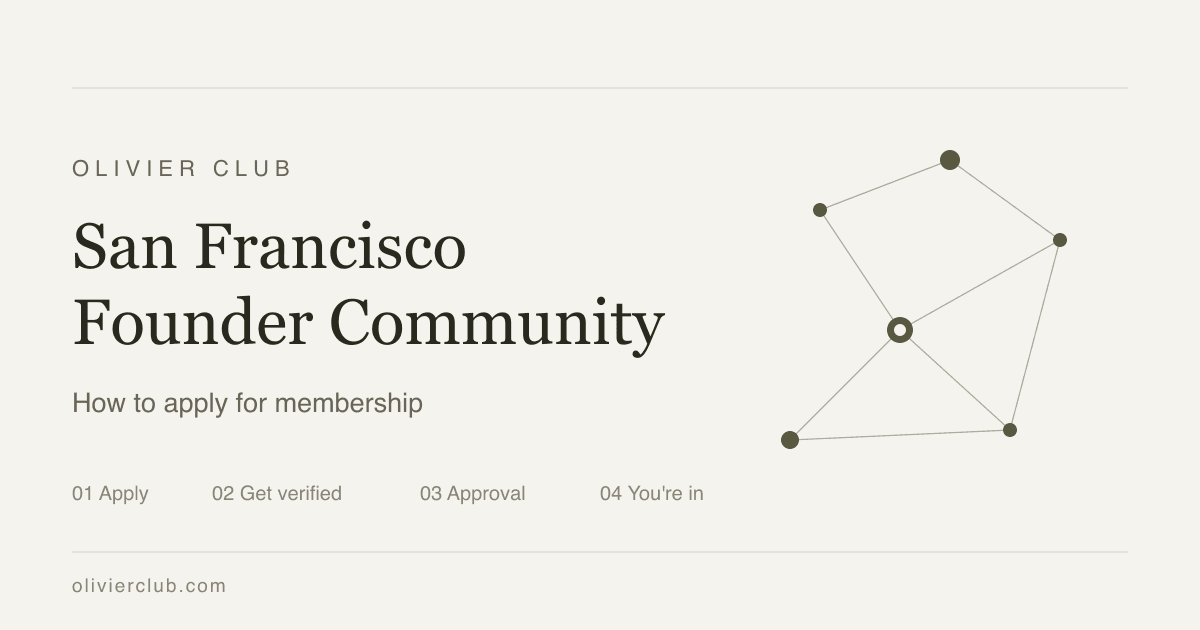
You start by applying online. Instead of a standard form, the application walks you through six short narrative questions about who you are and what you are building. It takes about ten minutes, and there is no application fee.
Applications are reviewed within 24 to 36 hours. A person reads every answer; there is no automated rejection. Reviewers are looking for the three signals above, not for credentials or a warm intro.
If the review goes well, you receive an approval email and schedule a call. The call is short and two-directional — the club confirms you are who the application says you are, and you get to ask what membership will actually do for you at your stage. After the call you choose a membership tier, complete payment, and you are in: exclusive events, workshops, the programs your tier includes, and a founder network that extends well beyond the Bay Area.
What does the application actually ask?
Most curated communities ask some version of the same six things, and Olivier Club asks them directly: what you call yourself, what conflict in the world you want to change, your vision of the solution, what led you here, how a person becomes a leader, and what you can teach others. There are no right answers and the reviewers are not grading prose. The questions exist because the answers predict what kind of member someone becomes — people who can name what they want to change and what they can teach tend to give as much as they take.
How much does a San Francisco founder community cost?
Across San Francisco and the Bay Area, pricing runs from free peer groups at the casual end to five-figure CEO peer groups and executive networks at the top, with most vetted startup communities landing between $100 and $500 a month. Olivier Club has three tiers. Core is $200 and includes pitch sessions and online workshops, a status tracker, an AI agent with outreach tools, mentorship workshops, and YC application review. Plus is $500 and adds one-on-one mentor calls and market intelligence lessons. Accelerator is $3,000 and adds the ten-week acceleration program, run offline and online, for founders pushing toward traction and investor readiness. Tier is chosen after approval, so the application itself commits you to nothing.
How to improve your chances of getting accepted
Write plainly and be specific. Reviewers at every vetted community read hundreds of applications that say passionate, driven, and disruptive; the ones that stand out say what the applicant is building, for whom, and what is currently in the way. Concrete beats polished every time.
For Olivier Club specifically, there is a second lever. Applicants can strengthen their application by spending a few minutes with Find Your Self, the club’s AI roadmapping engine. You tell it what you are building and where you are stuck, and it maps your next moves and the kind of people who can unblock them. It gives the review committee a much richer picture of how you think than six written answers alone, and it gives you a usable roadmap whether or not you join.
Where to start
If you are choosing between an exclusive entrepreneur community and a broader startup community, apply to the one whose room you actually want to be in, not the one with the best-known name. Read what the community does month to month, ask a current member what they got out of it, and pick the one aligned with your stage. If that room is Olivier Club, the application takes ten minutes and you will hear back within about a day.
And if part of your search is about where to physically work while you build, we cover that in a companion guide on coworking spaces near downtown San Francisco.